Bay window blinds
Three windows, two corners and not much depth. The corners are where bay blinds go wrong.
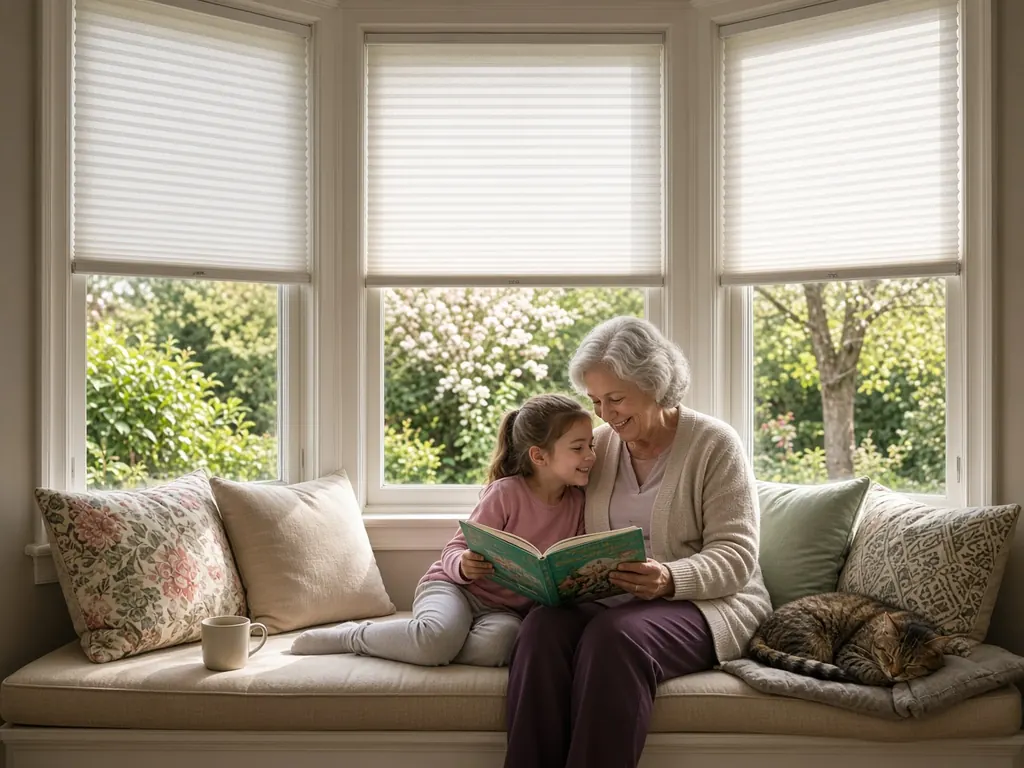
Short answer: give every window in the bay its own blind and headrail.[1 · Oct 29, 2026] If there's wall between the windows, measure each one like a normal inside mount. If the windows meet at the corners, the blinds will bump into each other, so mark where each one must stop first.[2 · Oct 29, 2026]
What a bay looks like
In many bays the center window is about half the total width and each side window about a quarter, with the sides angled at 30 or 45 degrees.[3 · Oct 29, 2026] A bow window has more sections in a gentle curve, and you measure it the same way.[2 · Oct 29, 2026] Most bays don't have much frame depth, so check it early.[2 · Oct 29, 2026]
Separated bay (wall between windows)
- Measure each window's width in three places and use the narrowest.[2 · Oct 29, 2026]
- Measure each height in three places and use the tallest.[2 · Oct 29, 2026]
- Order each as an ordinary inside mount; the factory takes its deduction, usually no more than ½ in.[2 · Oct 29, 2026]
Traditional bay (windows meet at the corners)
- Cut two squares of cardboard as wide as the blind's fully recessed depth (for example, 2½ in for 2 in faux wood).[2 · Oct 29, 2026][4 · Oct 29, 2026]
- Hold them in a corner so they stand in for the two headrails, with their corners just touching. Mark the inner edge of each on the frame.[2 · Oct 29, 2026]
- Repeat in every corner, then measure each window's width between the marks.[2 · Oct 29, 2026]
- Measure heights as usual, three places, tallest.[2 · Oct 29, 2026]
Bali's guide for wood and faux wood blinds adds: record the corner angles, keep the controls away from the corners, and expect the maker to take its own deductions. It warns that slats on neighboring blinds may not line up exactly, and some corner blinds can't raise to the same height.[1 · Oct 29, 2026]
Light gaps. Inside-mounted bay blinds leave gaps at the corners and sides. If that bothers you, consider an outside mount.[2 · Oct 29, 2026]
Outside mount on a bay
- Measure each window's width and height in three places and use the largest.[2 · Oct 29, 2026]
- Add 3 to 4 in to the width and at least 2 in to the height.[2 · Oct 29, 2026]
- If you're covering the trim, measure from the trim's outer edge to outer edge, and add 2 to 3 in to the height.[2 · Oct 29, 2026]
- There's no deduction on outside mounts.[2 · Oct 29, 2026]
Which blinds suit a bay?
Shallow bays favor products that need little depth: cellular and roman shades need ½ in to mount inside, faux wood ¾ in.[4 · Oct 29, 2026] Cellular shades also help with drafts and heat loss, which matters on big bays.[5 · Oct 29, 2026]
Affiliate links: if you buy through a link in this box we may earn a commission, at no extra cost to you. It does not change the sizes or sources on this page. How we handle affiliate links.
Sources: 1. Bali, Wood, composite and faux wood blinds measuring guide (PDF, hosted by a retailer). 2. Blinds.com, How to measure for a bay window. 3. Pella, Standard window sizes. 4. Levolor, How to measure windows for blinds and shades. 5. US Department of Energy, Cellular shades fact sheet (PDF). Checked Oct 29, 2026. Trademarks belong to their owners; figures are restated in our own words and tables, not reproduced.